What do border security personnel and Diogenes the Cynic have in common?
The commonality between border security personnel and Diogenes is: Both are looking for an honest man.
Diogenes the Cynic is considered the founder of Cynicism in philosophy; he was known for holding a lantern into the faces of people on the streets of Athens in broad daylight and asking, “I am looking for an honest man?” [1]. Diogenes was a great philosopher and a student of Antisthenes [2]. Antisthenes was one of Socrates’ students and helped Diogenes learn philosophy, which led him to pioneer Cyclicism [3]. Hence, he got the name Diogenes the Cynic. The real-life encounters of Diogenes with the citizens of Athens left a trace of a profound message on the subject of epistemology; he provoked reason, challenged social conventions, and broke cultural taboos.
Although Diogenes is no longer in this world, today, across all continents, immigration officers are still looking in broad daylight for the “honest man.”
A few years ago, an acquaintance of mine went to a city famous for its nightlife, cracks, and red districts. The immigration officer asked him, “What is the purpose of your visit?”
He is a witty person and never shies away from it; he replied to the officer in a humming voice, “If I tell you the truth and my plan for the next two nights, you might join me for a ride.”
After that, he replied in a normal voice, “Just here for tourism; hmm.. for two nights only. Aha, have some plans to taste old wine with new friends, visit some bright lights, and get cracked over this weekend”.
The officer replied, “Okay. When you are departing the country?”
He paused momentarily and said, “I’ll be back at work on Monday to mint for my next weekend trip.” he smiled and continued, “Just two nights stay.”
That was probably the day the immigration officer encountered an “honest man.” The officer gave him a near frowning look, picked up the rubber stamp from the corner of his desk, and smashed it on his passport.
The return of the passport through the glass window conveyed an underlying message without saying a word that the only exception in this encounter was the color of the passport. My friend had the audacity to tell the truth and exercised his hegemony because he knew that the color of his passport was much stronger than the color of the uniform of the immigration officer.
Most of the time, such encounters at the border control between civilians and law enforcement officers are a sheer clash of pride of their nationality and an argument of national pride.
National pride is very subjective and relative to the epoch of time. Every nation had its heyday. The only place you may find the hegemony and hubris of the great empires is in the dirt-covered pages of history books in the last row of the bookshelf in the old library.
In medieval times, nations were built on territorial boundaries based on shared social values such as linguistic, ethnicity, or religious beliefs. It was meant to recruit people in the army to fight; it was a way to protect their land, culture, identity, wealth, and, most importantly, their loved ones. The military used to be the strength of medieval nations; more people in the field meant a stronger nation.
Alas, everything has changed now. In the modern world, nationality is merely a membership of a more vital passport to travel. Modern nations are stronger not because of the size of their military but because of the size of their economy. In the event of war, more people will escape the country than the one who heads to the battlefield.
Leaders of the modern world have also realized that peace and prosperity are the only way to build a strong nation, and they don’t hesitate to attract talent and wealth in the name of immigration and investment, respectively. Those who don’t want to stay longer are still welcome in the alien country as expatriates and tourists.
Diogenes’s questioning with the citizens of Athens and questions asked to my friend by the immigration officer gave me the thought to make this 2×2 matrix for the ease of immigration officers. I might hand it over to one of such officers on my next cross-border trip.
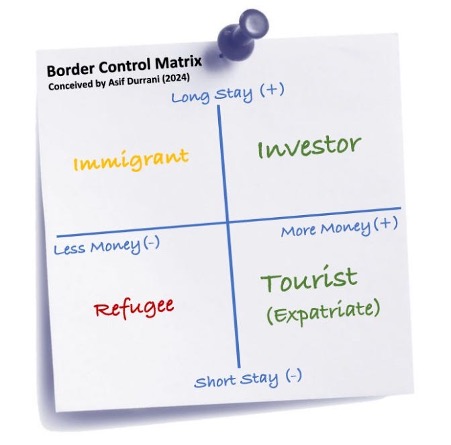
Today, there is a race to move to the west through sea, air, or underground tunnels. People walk miles through the treacherousDarién Gap to reach their dreamland[4]. But one should remember that everything is relative and subjective to the epoch of time; Bishop Otto of Freising (1158) acknowledged that “all human power and learning had its origins in the East.” [5]
If I ever had an encounter with an immigration officer like my friend had, I would not be honest with him. I will accept my mea culpa for being born in the wrong part of the world, at the wrong epoch of time, and then improvise the sentence of Diogenes the Cynic [6]. Like he said:
“I declared myself as a citizen of the world rather than claiming allegiance to just one place.” [1]
May the soul of Diogenes the Cynic rest in eternal peace and grant sanity to the immigration officers across the world.
Author: Asif Durrani
Dated: 03 Jan 2024
https://www.linkedin.com/in/asifdurrani
Also published at Medium
References:
[1] Diogenes the Cynic and his encounter with people of Athens:
[2] Antisthenes of Athens: https://www.bu.edu/wcp/Papers/Anci/AnciLuz.htm#:~:text=Antisthenes%20of%20Athens%20(445%2D360,the%20history%20of%20Greek%20philosophy.
[3] History of Cynicism
[4] Migrants through the treacherous Darien Gap
https://edition.cnn.com/2023/04/17/politics/darien-gap-migrants-panama-what-matters/index.html
[5] Formation of Nations
https://www.sciencedirect.com/topics/social-sciences/formation-of-nations
[6] Mea Cupla meaning: https://www.vocabulary.com/dictionary/mea%20culpa#:~:text=This%20is%20a%20Latin%20phrase,wrong%20and%20apologizing%20for%20it.
 Asif Durrani